Carmina Burana – Carl Orff
June 6, 2026
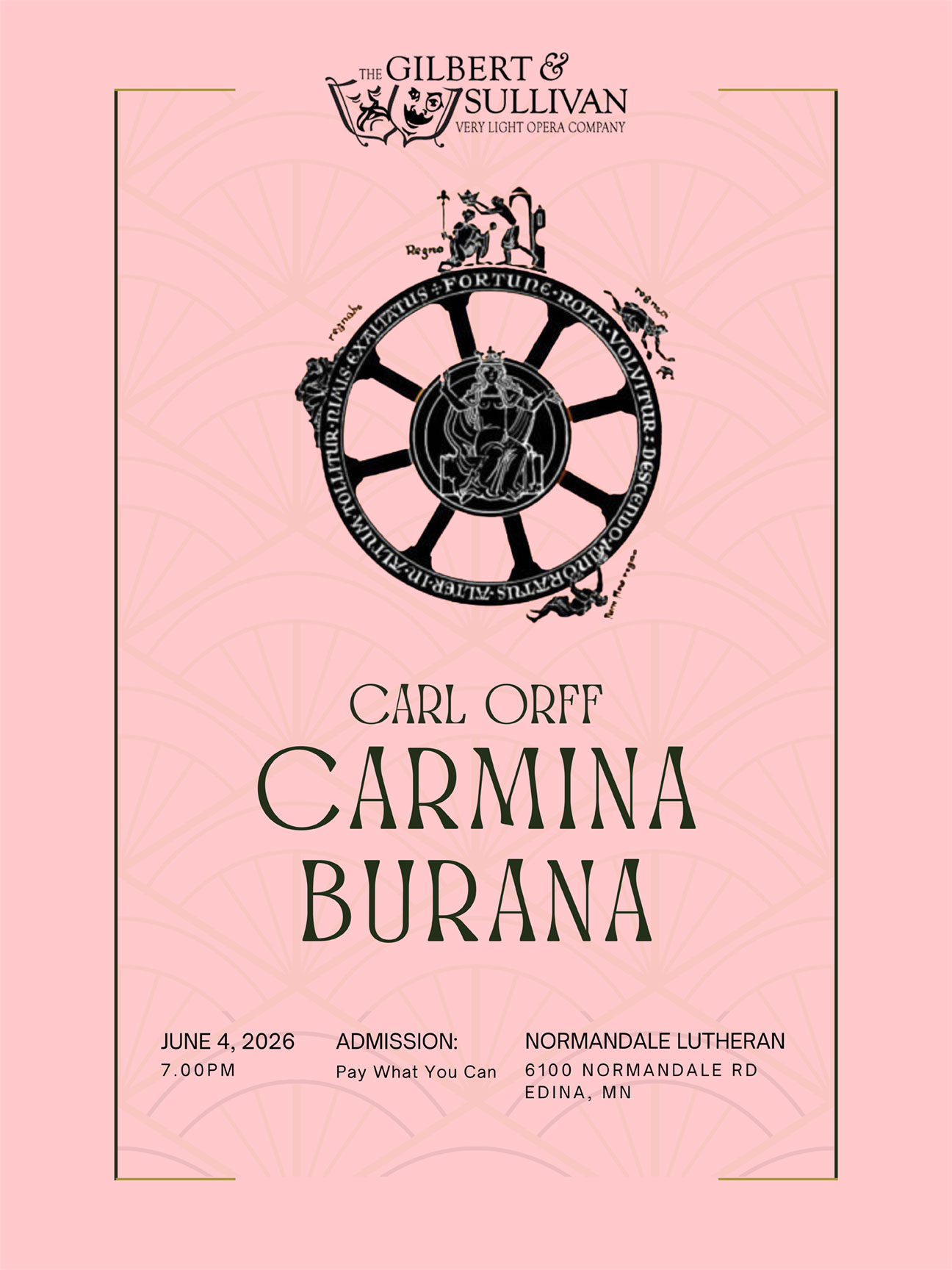
The Gilbert & Sullivan Very Light Opera Company presented Carl Orff’s Carmina Burana, with chorus, soloists, and orchestra under the direction of Dr. Randal Buikema. The piece was performed at Normandale Lutheran Church in Edina.
Carmina Burana, by Carl Orff
Carl Orff (1895-1982) was one of the most compelling twentieth century musical educators and composers. In a fit of personal criticism in 1935, he tossed out almost everything he had composed up to that point and dedicated himself to finding new forms of expression and a new orientation. The Romantic and Classical period had “run their course” in his mind, and it was time to begin anew. Orff found his new niche in music which relied heavily on plainchants, repetitive rhythmic forces, blazing orchestration, encapsulated in a wild neo-primitivism. All of these came to roost in Carmina Burana.
Throughout the tenth to thirteenth centuries groups of vagabond hobo poets, defrocked clergy, and drop-out students roamed throughout Europe and were known as Goliards or Vagabonds. Compared to the elegant, elevated poetry of troubadours and minnesingers, the vagabonds/goliards spoke in earthy, explicit, language from a cynical, irreverent perspective. Their personal lifestyle was filled with gambling, drinking, vices of many sorts, thievery and begging, social/religious criticism, and commitment to “the free life,” all of which was duly recorded in their writings, verbal and musical.
Carmina Burana, Songs of Beuren, is based on a collection of thirteenth century Goliardic poems and songs found in a manuscript at the Monastery Benediktbeuren, located approximately fifty miles southwest of Munich, in 1803; although, some believe that the manuscript came from Seckau. These two hundred and fifty poems, songs, and tiny plays addressed corruption of the clergy, fate and its fickle nature, and also included lusty love songs, drinking and gaming songs, written both in Latin and the German vernacular.
In 1935 Carl Orff read the collection compiled by Johann Andrea Schmeller in 1847, and he decided to use the texts in the first section of a contemplated trilogy of cantatas titled Carmina Burana, Catulli Carmina, Trionfo di Afrodite. By 1936 Orff finished the first part, and Carmina Burana premiered in Frankfort Germany on June 8, 1937. The American premier followed many years later in San Francisco on October 3, 1954. One of the reviews assessed that the cantata was “one of the most vivid, picturesque, and richly tuneful choral pieces of modern times”; Olin Downs wrote that Carmina Burana was “one of the most fascinating and delightful choral works that this century has produced on either side of the water.”
There are three parts in the cantata. These are flanked by a large introduction and conclusion dominated by a brutal, controlling ostinato or repeating figure and a text which speaks of fickle, perpetual, determinative Fate. The three subsequent sections are Springtime, discussing the joys of the season, In the Tavern, discussing the fun of drinking and gambling, and The Court of Love, hedonistic and sensual commentaries on physical love. Rhythm, expressed through a vastly expanded percussion section for which five percussionists are required, rides herd over lyricism and harmony in fierce, hypnotic, pounding structures. Grove’s Dictionary characterizes Carmina Burana as “music of powerful pagan sensuality and direct physical excitement.”
© Indianapolis Symphony Orchestra, 2017
Participants
Conductor
Dr. Randal Buikema
Soloists and Chorus
Wilson Alness, Joe Andrews, John Azbill-Salisbury, Scott Azbill-Salisbury, Don Barbee, Janice Barbee, Waldyn Benbenek, Mary Benbenek, Amanda Bindner, Katelyn Breen, Michael Burton, Dylan Croeker, Kelly Danger, Jonathan Flory, Alexander Gerchak, Willow Gerhard, Scott A. Gorman, Erin Grams, Louise Halverson, Liza Hartshorn, Kathy Hering, Kat Felicis Ioco, Ron Jay, Kate Jennings, Amanda Jensen, Ryan Johnson, Trenton Johnson, Ella Rose Katzenberger, Kristen Kinnear-Ohlmann, Maria Kosovich, Therese Kulas, Eric Laska, Kevin Lindee, Adam Lowe, Holly MacDonald, Anna Maher, Nick Menzhuber, Tony Palumbo, Andrew Peterson, Matt Polum, Mackenzie Powell, Rich Powell, Mallory Rabehl, Richard Rames, Bryan Reed, Lowell Rice, Emma Shine, Charlotte Smith, Rhea Sullivan, Lara Trujillo, Sam Vinitsky, Angela Walberg, Riley Webster, Josh Weisenburger
Orchestra
Violin 1
Victoria Athmann – Concert Master
Sue Bennefeld, Beth Henningsen, Jill Lestina-Warnest, Amy Letson, Suki Sun
Violin 2
Karen Kozak, Betsy Lofgren, Lorine Menzhuber, Karen Neinstadt
Violia
Louis Berg-Arnold, Laura Bidgood, Gretchen Cerny, Teresa Mager, Aija Ronis
Cello
David Downing, DJ Gallagher. Sara Autumn Hertz, Karin Holmberg Kimble, John Orbison
Bass
Benjamin Kitt, Ann Marie McIntire
Flute
Sue Benson, Joseph Wypych, Kris Henderson
Oboe
Lorelei Giddings, Donna Votino
Clarinet
Barb Hovey, Barb Sabal
Bassoon
Ford Campbell, Gene Scholtens
French Horn
Mike Engh, Ken Lovely, Bob Olsen, Cristina Werling
Trumpet
Bob Zobal, Alan Jermiason, Doug Snapp
Horn
Ken Lovely, Mike Engh, Cristina Werling, Bob Olsen
Trombone
Jason Adriano, Sarah Cooke, Charles Watt
Tuba
Greg Sackreiter
Percussion
Emily Curran, Kelly Grill, Julie Henry, Kevin McBeth, Eric Neseth, Charley Rich
Piano / Rehearsal Accompanist
Franco Holder
Orchestra Manager
Lorine Menzhuber
Movements
Fortuna Imperatrix Mundi
| 1. | O Fortuna | Chorus |
| 2. | Fortune plango vulnera | Chorus |
Primo vere
| 3. | Veris leta facies | Chorus |
| 4. | Omnia sol temperat | Alexander Gerchak |
| 5. | Ecce gratum | Chorus |
Uf dem anger
| 6. | Tanz | Orchestra |
| 7. | Floret Silva | Chorus |
| 8. | Chramer, gip die varwe mir | Chorus |
| 9. | Reie | |
| Swaz hie gat umbe | Chorus | |
| Chume, chum, geselle min | Chorus | |
| Swaz hie gat umbe | Chorus | |
| 10. | Were diu werlt alle min | Chorus |
In Taberna
| 11. | Estuans interius | Scott A. Gorman |
| 12. | Olim lacus colueram | Michael Burton & Chorus |
| 13. | Ego sum abbas | Adam Lowe & Chorus |
| 14. | In taberna quando sumus | Chorus |
Cour d’ amours
| 15. | Amor volat undique | Charlotte Smith, Emma Shine |
| 16. | Dies, nox et omnia | Jonathan Flory, Kate Jennings |
| 17. | Stetit puella | Anna Maher |
| 18. | Circa mea pectora | Matt Pollum |
| 19. | Si puer cum puellula | Waldyn Benbenek & Chorus |
| 20. | Veni, veni, venias | Double Chorus |
| 21. | In trutina | Lara Trujillo |
| 22. | Tempus et iocundum | Angela Walberg, Alexander Gerchak & Chorus |
| 23. | Dulcissime | Ella Rose Katzenberger |
Blanziflor et Helena
| 24. | Ave formosissima | Chorus |
Fortuna Imperatrix Mundi
| 25. | O Fortuna | Chorus |
| Solo covers: Katelyn Breen, Liza Hartshorn, Don Barbee, Maria Kosovich, Kat Felicis Ioco, Ryan Johnson |
Donors:
This concert was made possible through the generosity of four anonymous major donors of $1000 or more.
Additional Contributors, including donations following the 2025 Brahms Requiem concert:
Joe Andrews, Philip Asgian, David Barbee, Don and Janice Barbee, Andrew Barrett, Waldyn Benbenek, Brahms Requiem (2025) Chorus and Orchestra in honor of Dr. Randal Buikema, Kay Dennis, Ray Dillon, Hank Forman, Sherry Gwegorryn, Eric Henningsen, Nancy Homdrom, Rhonda J. Johnson, Kathleen Kirsch, Anne Klueh, Carol Manning, Robert Messier, Mary Pendergrass, Jeffrey Petty, Angela Robinson, Sallie Skinner, Rhea Sullivan, Brooke Timp, Laurie Waters, Alan Zabel, and many others through their free will donations
GSVLOC Board:
| Producer: | Stephen Hage |
| Secretary: | Lowell Rice |
| Treasurer: | John Orbison |
| Labour Pool Coordinator: | Eric Pasternack |
| Publicity: | Waldyn Benbenek |
| Women’s Chorus Representative: | Therese Kulas |
| Men’s Chorus Representative: | Tom Berg |
| Orchestra Representative: | Barb Hovey |
Acknowledgements:
Therese Kulas (poster design), Waldyn Benbenek, (technical), Charles Rich (logistics), Kevin Lindee (PowerPoint supertitles), Loren Wolthoff (Production Specialist), Richard Rames (program layout), Normandale Lutheran Church, Saint Christopher’s Episcopal Church, Saint Paul Academy, Tim Kraack